Thursday, January 23, 2014


 GEORGE WASHINGTON


George Washington grew up in a plantation worked by enslaved African Americans. He went to school for just seven or eight years in which his favorite subject was arithmetic. He learned to ride horses, fish, hunt and boat. All this skills helped him later on during war. At the age of fifteen he got to see pretty much the whole country by apprenticing to surveyors. When George Washington was twenty he became part of the Virginia militia. There he learned that working as a non-British- born officer would offer him less pay even thought they had the same rank. He still carried the British flag to the battle known as the French and Indian War  against  the French and Native Americans.
       He went to British missions three different times to try to take Fort Duquesne. In the three missions he was defeated. In the first one they did not reach their destination, and created 60 miles away from it  Fort Necessity. Later it was surrendered against French troops.Washington was allowed to go back to Virginia where he was told that all colonial officers had to drop a rank, but he resigned. General Edward Braddock went with him on the second mission but the consequences of the results were worst. The French defeated the British troops and Braddock was shot dead. In 1758 the troops set out again to take Fort Duquesne, and after being hurt throughout, later that year they found it burned to the ground by the retreating French.
        After all this, Washington gave up his commission and went back to his house in Mount Vernon. He was asked to come back twice, once unpaid as advisor and another time. He stayed home until the end of the war in 1763. After all this years in the field, he learned the important lesson that the British could be beaten. In 1758 Washington was elected to the House of Burgesses. He served 15 years in all.  In 1759 Gorge Washington married  Martha Custis. Their  wedding and reception took place on Martha's plantation, called the White House.They were happy for many years until war came again.
 George Washington was elected for the First and Second Continental Congress. He was also named the Commander in Chief of the armed forces. Also he was the most experienced officer of the Continental Army, which was because all the wars he had fight with the British. George Washington finally becames the first president of the United States of America.


The Continental Army

On June 15, 1775, the Second Continental Congress chose George Washington to be commander in chief. He was chosen for his military experience and because he came from the most important of the Southern Colonies: Virginia. He also had an impressive appearance and a confident manner which made him a likely candidate alongside his excellent participation in the military committees. Washington recognized that he did not have the experience or the knowledge to command an entire army of men. His experience came from being in the frontier during the French and Indian War where he commanded a brigade of troops. He was the first colonist to command such a large group of men. He also gained experience during his political leadership in his native Virginia and when directing the business affairs of his plantation at Mount Vernon. Along with his experience, George Washington was very determined, a good leader and a unshakable sense of honor and duty. 


Washington took formal command of the army on July 3, 1775. He described the army at first as a "mixed multitude of people under very little discipline order or government." He was a very firm believer in discipline. In fact, he wrote: "Discipline is the soul of an army. It makes small numbers formidable; procures success to the weak and esteem to all." He also wanted to control the comings and goings of officers and men by instituting roll calls and strength returns. Other things he altered was to make the distinction between officers and enlisted men more rigid, along with introducing new punishments like the lash, pillory, wooden worse, among others. But Washington had other duties. Not only did he establish discipline in the existing army, but he also had to form a new one enlisted specially for the Continental service. After the congress with the congressional committee, the plan for the new army emerged. This new army would be composed of 26 regiments of infantry of 728 men each, plus one regiment of riflemen and one of artillery men. 


In the year of 1776, 20,372 men were uniformly paid, supplied, administered and enlisted. The general, by choice, received no salary throughout the revolution. The plan on paper seemed plausible but when Washington tried to put it in action, he found he could not do it. The army resisted the reorganization and were reluctant to enlist for another year's service as that would mean abandoning their farms and families. Another problem Washington faced was the lack of supplies. However, these were easily arranged as the Congress and individual colonies sponsored trips to the West Indies, where they bought war materials from the French and Dutch exhortations. They also obtained supplies when Washington sent troops to capture British ships. When the British left, the stores of cannon and ammunition the British were forced to leave behind were a welcome addition to the meager American arsenal and helped win the revolution.


Friday, January 17, 2014

     Declaration of Independence

         It all started with the revolutionary war of Lexington and Concord on April 19, 1775. The Second Continental Congress gathered to discuss about their independence. They did not want to be part of theBritish Empire, but instead fight for their freedom. This was on May  of that same year. Tension in America grew stronger between colonists who wanted to be independent and Loyalists who remain loyal to the crown. On June 11,1776 almost one year after, the Second Continental Congress appointed a committee to write the Declaration of Independence from British rule. This committee was called the Committee of Five since five people were part of it. This five men were  Thomas Jefferson, John Adams, Benjamin Franklin, Robert Livingston, and Roger Sherman.  The committee decided Thomas Jefferson should write the first draft. Jefferson wrote it and the committee declared it was almost perfect. This document was presented to the Congress after few corrections were made on June 28,1776.  After a few more corrections, Jefferson's work was approved.


Declaration of Independence
Thomas Jefferson


       Af first not everyone agreed on declaring independence. Some thought that they should wait until the colonies had stronger alliances with other countries. When voting, on the first round South Carolina and Pennsylvania voted against while New York and Delaware did not vote. The Congress wanted  for the vote to be unanimous, and since it didn't happen they continue to discussing it. The next day, South Carolina and Pennsylvania reversed their votes and said yes. Delaware also decided to vote yes. This meant that the agreement  to declare independence, passed with 1 abstention from New York, who chose not to vote and 12 votes that said yes.


       On July 4, 1776 the Congress decided to adopt the final version of the Declaration of Independence.  56 members of the Congress signed it. John Hancock was the first one with a signature of almost 5 inches long. After the document was signed, they sent it to a printer to make more copies. This copies were later on send to all the colonies. The Declaration of Independence was published on newspapers or read aloud. Also a copy was sent to the British government.


Quote from the Declaration of Independence

 "We hold these truths to be self-evident, that all men are created equal, that they are endowed by their Creator with certain unalienable Rights, that among these are Life, Liberty and the pursuit of Happiness."

Battles of Lexington and Concord

        On April 15,1776, General Thomas Gage, appointed military governor of Massachusets, was ordered to capture John Hancock and Samuel Adams and to seize the weapons at Concord. To accomplish this he assembled "The Flanking units" from his Boston Garrison. In charge of the mission were Lieutenant Colonel Francis Smith and Marine Major John Pitcairn. Gage did not inform his officers of his plans until the last minute in an effort to keep it a secret. However, many rebels were settled in Boston to spy on the British. Rebels knew of the British's every action and when the plant was put into motion, the entire countryside had been alerted to their presence. At midnight on April 19th, 650-900 troops left Boston to March towards Concord. Unknown to them, they were followed closely by alarm riders Paul Revere and William Dawes.

          
        At dawn, the troops under the command of Major Pitcairn arrived at Lexington Green. A group of armed militia led by John Parker stood in formation. Parker ordered his men to disperse when the first war shot was was heard. This shot was called "the shot heard round the world". No one knows who fired the first but upon hearing the shot, the British army fired upon the militia, killing eight and wounding ten more. The militia retreated into the woods to avoid British fire. The army now advanced to Concord and at Concord North Bridge encountered a group of armed militia. The British retreated to Concord Center.

        When Smith decided to return to Boston, militia and minutemen from surrounding town cornered the British. Americans did not fight as British men did. Colonists formed small squads and company tactics to flank the British. Americans fought from behind the trees, walls, etc. This fighting style caused British troops to break ranks while they retreated toward Lexington. At Lexington, Lord Percy used his two cannons to disperse the colonists and collect British troops. The British suffered many losses, nearly 20% deaths. At Boston, loyalists and British were confined by the Patriots. However, this event led to more colonists joining the cause of independence.

Friday, December 6, 2013


Boston Tea Party


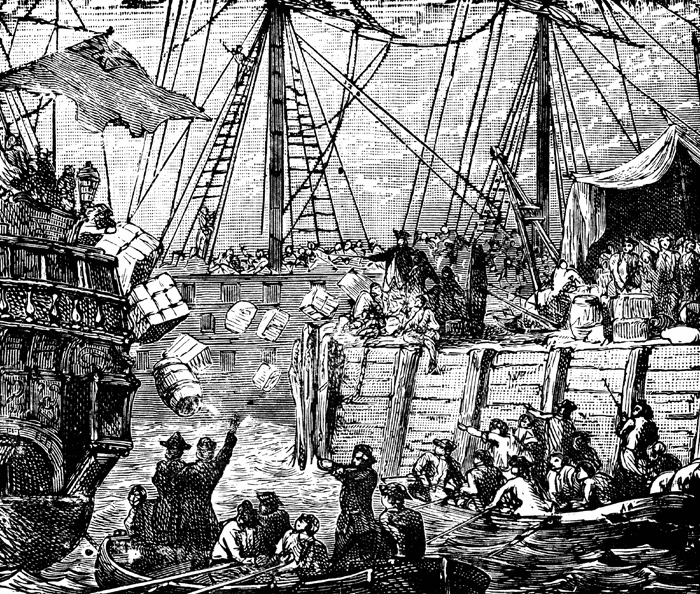
American colonists had  been affected by taxes put by parliament. They saw this taxes as another example of taxation without representation. Colonists had no representation in parliament, therefore they could not vote in favor or against this taxes. Tea was one of the favorite drinks among colonists and British decided to pass on the Tea Act. A tax had already been  put on tea and colonies didn't approve it,This act would almost guarantee that the colonists would buy tea form the East India Company. The East India Company sold the tea extremely cheap even with the taxes, but colonists didn't buy it because they thought they were being tricked by the parliament. Instead, colonists bought  the smuggled Dutch tea.Colonists got really angry and they thought they should do something to make the British know that they did not like this. On December 16, 1773 the Sons of Liberty lead a nonviolent protest in which they disguised as Mohawk Indians and bordered three British ships. This were the Darthmouth, Eleanor and the Beaver. This ships were full of tea because colonists were not buying it. Thomas Hutchinson, the Boston governor,did not allow the tea to be sent back to England. Colonists dumped 342 crates full of tea overboard. This was about 90,000 pounds of tea. This event was known as the Boston Tea Party.
Even though the colonists were disguised as Native Americans, British knew that colonists had done this. The same day there had been a meeting led by Samuel Adams which was for discussing the taxes on tea. It is unclear if this event was planned by Samuel Adams or if just a group of people got mad and decided to do this. We know that this was an action done by colonists to defend their rights. The business of tea had been long affected due to this taxes. Colonists definitely believed that they should do something to solve this problem. The Boston Tea Party was a key event for the American Revolution.

The Boston Massacre

The Boston Massacre was a fight that happened on March 5th, 1770 between a drunken crowd or colonists and British soldiers. The name "Boston Massacre" was given to the event by the Sons of Liberty, particularly by Samuel Adams. Five colonists were killed. Three died on the post and two were wounded and died afterwards. The victims of the incident were a black sailor named Crispus Attucks, a ropemaker by the name of Samuel Gray and a mariner called James Caldwell. Those who died afterwards were Samuel Maverick and Patrick Carr.

    Crispus Attuks, black sailor


The occurence began with a crowd of drunk colonists following and attacking a soldier. The soldier took refuge in the House of Customs, where several soldiers were protecting the custom officials. These soldiers were led by a British officer named Captain Thomas Preston. As the colonists continued to attack, the soldiers' increasing anxiety caused them to fire, despite Preston's orders. This led to the resultant deaths of the five colonists. A town meeting was called demanding the removal of the British troops and a trial for the captain and his men for murder. Six colonists were wounded in this accident.

    The Boston Massacre, by Paul Revere

The trials for the captain and his men were two of the longest in history. It was the first time a judge applied the term "reasonable doubt". The captain and his soldiers were defended by John Adams and Josiah Quincy II. They won the trial and gained the release of the soldiers. Two of them were found guilty afterwards for manslaughter. The accused soldiers were:

Captain Thomas Preston
Corporal William Wemms
James Hartigan
William McCauley
Hugh White
Matthew Kilroy
William Warren
John Carrol
Hugh Montgomery

The British were tried before the Superior Court of Judicature, the highest court in Massachusetts.

    John Adams, defense lawyer


Federal Hall where the Stamp Act Congress took place

The Stamp Act


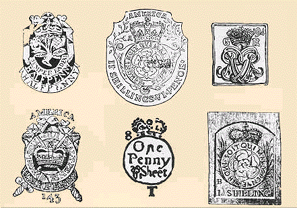
Colonists were angry since parliament had been taxing them. The Stamp Act , was passed March 22,1765 but was going on effect until November 1 of that same year. It became the  first direct British tax. The Stamp Act stated that colonists had to pay a tax on all printed paper such as magazines, newspapers, books, deeds and legal documents. This Act was called like this because colonists were supposed to buy paper from the British. This paper would have a stamp that showed that the colonists had payed the tax. The tax had to be payed with the British currency and not with the colonial money. The purpose of this tax was to help pay the troops in colonial America after British had won the French and Indian war. The British government thought that the colonies had received the most benefit from the soldiers  so they should at least help the British pay for them.
On the other hand the colonists thought they should not pay taxes on something they had been doing for free many years. They thought that there was no need for the taxes or the troops. Colonists believed this was  another example of taxation without representation. They argued that since they didn't have a vote in parliament they should not be paying a tax for them. Colonists thought they could only be taxed by their own representatives.  The colonists responded to this act with legislative protests and street violence. Colonists believed that this threatened their prosperity and their liberty, and that if they accepted this tax  many more would come. Everyone who was in favor of the Stamp Act was considered an enemy of the colony.

In response to this situation,the colonists gathered in the Stamp Act Congress. This was the first congress of the american colonies. Representatives from nine of the thirteen colonies went to New York City from October 7 to October 25 ,1765. The purpose of the congress was to organize a protest against British taxation. Representatives of this colonies decided on the non importation agreements. This meant that they wouldn't buy any British product. England was strongly affected by this economic boycott so they repealed the Stamp Act. Even though parliament  repealed the Stamp Act on the same day they  passed the Declaratory Act which stated that the parliament had the right to tax and make laws in the colonies.