Friday, March 7, 2014

The Treaty of Paris of 1783

After the defeat of the British at Yorktown in October, 1781, leaders in Parliament decided that the war in America should stop. The British also lost colonies in the Caribbean. With more people seeking peace, Lord North's government fell in late March 1782 and was replaced by one led by Lord Rockingham. Learning this, Benjamin Franklin wrote to him asking him to begin peace negotiations. Rockingham agreed as it was necessary to him. Franklin's fellow negotiators, John Adams, Henry Laurens and John Jay felt they could not make this negotiation without French approval. British decided that they would not accept American independence as a precondition. 


Rockingham died in July 1782 and Lord Shelbourne became the head of the British government. The French delayed the process as they were working with Spain to capture Gibraltar. In addition, the French sent a secret envoy to London as there were several issues, including fishing rights on the Grand Banks, on which they disagreed with their American allies. The French and Spanish were also worried about American insistence on the Mississippi River as a western border. In September, John Jay learned of the secret French mission and wrote to Shelburne saying he shouldn't heed the French and Spanish. The Americans then received notification of a letter sent by Shelburne to George Washington agreeing on independence. Now that independence was agreed upon, Americans began discussing the details of border issues and reparations. The British agreed on the borders established after the French and Indian war rather than those set by the Quebec act of 1774. 

On November 30, Americans and British signed a preliminary treaty. These were some of the stand conditions:
Great Britain recognized the Thirteen Colonies to be free, sovereign and independent states.
The borders of the United States would be those of 1763 extending west to the Mississippi.
The United States would receive fishing rights on the Grand Banks and Gulf of St. Lawrence.
All contracted debts were to be paid to creditors on each side.
The Congress of the Confederation would recommend that each state legislature provide restitution for property taken from Loyalists.
The United States would prevent property from being taken from Loyalists in the future.
All prisoners of war were to be released.
Both the United States and Great Britain were to have perpetual access to the Mississippi.
Territory captured by the United States subsequent to the treaty was to be returned.
Ratification of the treaty was to occur within six months of signing.
With reluctance, the French also signed the treaty. The terms provoked much discord in Britain. Shelburne was forced to resign and the Duke of Portland was put in charge. The duke hoped to modify the treaty to include the loyalists among other things. These conditions were not accepted. The American delegation and the British singed the treaty of Paris on September 3,1783. The treat was ratified on January 14, 1783. 


The Battle of Yorktown - The Last Battle

The Battle of Yorktown was the last battle fought in the Revolution. It was fought September 28 to October 19, 1781. General George Washington commanded the American army of 8,800 soldiers. The 7,800 French soldiers were commanded by Lieutenant General Jean-Baptiste Donatien de Vimeur, comte de Rochambeau. On the enemy side, the 7,500 British men were commanded by Lord Charles Cornwallis. In August 1781, General George Washington learned that Lieutenant General Lord Charles Cornwallis' army was encamped near Yorktown. After discussing options with his French ally Washington decided to quietly move his army away from New York City with the goal of crushing Cornwallis' army. They departed in August 21, 1781.


Rear Admiral Comte de Grasse supported this plan and agreed to help by blocking the British entry through the Chesapeake. On September 5, a British fleet led by Rear Admiral Sir Thomas Graves arrived and attacked the French. This resulted in a battle. De Grasse defeated the British and led them away from the bay. Washington arrived at Williamsburg on September 17 and met with De Grasse to ensure he remain in the bay. They joined forces with Marquis de Lafayette and with the army assambled, Washington and Rochambeau began the march to Yorktown on September 28. A Franco-American army was led by the Comte de Choissey to oppose the British on Gloucester Point. Cornwallis was outnumbered 2 - 1. 

For the next three days following the night of October 5 and 6, French and American guns fired against the British. Feeling himself losing, Cornwallis wrote to General Henry Clinton on October 10 calling for help. Their situation worsened because of a smallpox outbreak in the town. On the night of October 16, Cornwallis shifted 1,000 men and his wounded to Gloucester Point with the goal of transferring his army across the river and breaking out to the north. This plan was interrupted when a storm scattered them. Out of ammunition for his guns and unable to shift his army, Cornwallis decided to open negotiations with Washington. At 9:00 AM on October 17, a single drummer mounted the British works and beat the long roll as a lieutenant waved a white flag.

The fighting at Yorktown cost the allies 72 killed and 180 wounded. British losses were higher and included 156 killed, 326 wounded. Cornwallis signed the official surrender papers on October 19. At noon the French and American armies lined up to await the British surrender. Two hours later the British marched out with flags furled and their bands playing "The World Turned Upside Down." Claiming he was ill, Cornwallis sent Brigadier General Charles O'Hara in his stead. Approaching the allied leadership, O'Hara attempted to surrender to Rochambeau but was instructed by the Frenchman to approach the Americans. As Cornwallis was not present, Washington directed O'Hara to surrender to Lincoln, who was now serving as his second-in-command. 

Valley Forge

"These are the times that try men's souls." Thomas Paine

The Continental Army had suffered many defeats. The British had captured Philadelphia and the continental army could not get it back. Washington had no place to settle his troops. He finally decided on taking them to Valley Forge, located 20 miles outside Philadelphia. He could keep an eye on the British while he decided what to do next. Although no battles were fought, many men died. The continental army remained camped at Valley Forge for 6 months during winter. Men had no food, medicine or clothes and had to sleep in small log cabins. They were hungry, sick and cold and anxious to go back to their families.

George Washington worried that when their stay at Valley Forge ended, he might no longer have an army. Most of his men were farmers with families, not soldiers. However, he was determined to keep his army together. The war was not about territory, it was about freedom. The army knew it, but were unhappy with their series of defeats. They were cold, hungry and dying while the British were warm and happy at Philadelphia.
Washington needed soldiers who would not just fight effectively but would also show the idea of freedom. Washington needed that people at home would also be strong so they could provide food, clothing, information and morale.

Martha Washington was a wonderful help for Washington's plans. His soldiers were having severe problems. They were starving and freezing since they used thin clothes and rags in their feet. Martha helped them by donating as much food as she could and sewing more adequate clothes.
Even though she was tiny, she was organized and powerful. Martha managed to convince other women to help her. Soldiers who survived called her "Lady Washington" since they knew that without her they wouldn't have managed to survive. Baron Von Steuben also help the army become more professional. He taught  them how to march, fight and follow orders. Troops continued to receive help and when they marched away, Washington knew his army had become better and that he had archived his goal.


Cornwallis

Charles Cornwallis lead several wars throughout his life securing British victories at New York, Brandywine and Camden. In 1781 he became second in command to Henry Clinton. Cornwallis lead his troops down to Virginia. This was when he lost at Yorktown. This was what marked the end of war and made a final decision. Before going to America, Cornwallis served for the army of Germany during the Seven Year War. He became major general in 1775. Cornwallis use to work under Clinton's orders. 

George Washington had surprised him in the crossing of the Delaware. Washington had also beat him the the Battle of Princeton. However he outflanked Washington's position in the Battle of Brandywine. Cornwallis was named second in command of the British army. This gave him even more responsibility. Cornwallis lead the Battle of Monmouth Courthouse. When Clinton departed to New York on June 8 and since Cornwallis was second in command, he had to lead the troops in the South. 
Cornwallis managed to defeat Horatio Gates at the Battle of Camden. The American militia seemed as if they couldn't confront them. Because of this North Carolina was left exposed to British. Cornwallis believed he should have captured North Carolina but was delayed since there was a hit weather,  his food supplies had been stolen and his troops got sick.

Cornwallis seemed unable to control South Carolina because American patriots were strong there. He wanted to go back to the north and cut the American supplies. According to him, this way he would be 
able  to go back go the south settlements. British crossed Roanoke and they went to fight a decisive battle in Virginia. The lack of loyalist support made it unable to accomplish his goals. Instead he had to settle in a low lying, not fortified place in Yorktown. This was when he saw the American and French strength. Cornwallis got aware that he could not escape and had to surrender. However this defeat did not affect his reputation that much. This was because he was sent to India as commander in chief of a new army.

Benjamin Franklin

Benjamin Franklin was born in Boston on January 17, 1706. He was the 15th of 17 children and that is why his family was poor. This was why Benjamin had to look up for himself which made him even more independent. When Benjamin was 12, he worked with his brother James as an apprentice and even wrote some of the articles himself. All of this were published anonymously since they thought no one would be interested in the writings of a teenage boy.  At the age of seventeen, Franklin ran away from home. He wanted to live his life by his own so he moved to Philadelphia. The next year he traveled to London to work in a print shop. Two years later he went back to America, but did not return to his house. Instead he went to Philadelphia again were after two years he opened his own print office. Benjamin Franklin was twenty three when he bought the Pennsylvania Gazette and hoped to make it the best newspaper it could be. After a year, he married Deborah Rogers with which he had three children. Two of them survived to adulthood and Francis born in 1732 died at the age of four. In that same year, he published the Poor Richard's Almanack under the name Richard Saunders. Franklin kept publishing the Gazette until 1748 when he sold it and retired from printing. Benjamin Franklin was active in his community, he founded a volunteer fire company, became the city's postmaster, organized the Philadelphia militia, helped create Pennsylvania's first university, organized the first city hospital, and the first subscription library in Philadelphia.  


Curiosity was a key factor for Benjamin's inventions. He wanted to know why things worked the way they did and how to make them better. Throughout his life he created different things. First of all, he invented what today is known as bifocals. Since he had poor vision and was tired of taking away and putting back again his glasses, he wanted to invent a way to see both near and far. What he did was that he cut two pair of spectacles in half and put half of each lens in a single frame. Franklin wanted to help his older brother John who had kidney stones, so he developed, a flexible urinary catheter that is is known to be the first one produced in America. Throughout his life, Franklin made several voyages which allowed him to learn about ships. He suggested following the Chinese model of dividing the watertight compartments so if a leak occurred, the water would not spread throughout the ship. Benjamin did not invent the electricity however he did invent the lightning rod which protected the buildings and ships from lightning damage. People in America used to build a fireplace to warm their homes even if it was dangerous. Benjamin Franklin built an iron furnace stove which was called Franklin stove. This stove allowed people to get warm under safer conditions. Franklin also invented an odometer to keep tack of the distance he traveled while delivering the mail. When Benjamin was old, and already retired, he wanted to spend his time reading but discovered that he didn't reach the high book shelves. This is why he invented a long arm which was a wooden pole with a grasping claw at the end to make it easier for him to reach his books.


Benjamin Franklin had a long political life. He first served in Pennsylvania's colonial legislature. During the French and Indian War he was elected to represent Pennsylvania at the Albany Congress making one of the first proposals to bring the colonies together under a central authority. The Congress accepted it but the colonial legislatures rejected it since they saw it as a threat. Years later he went to London in representation of several colonies and when the Stamp Act crisis arose, he spoke against it demonstrating he now believed on taxation without representation. 1775-1776 Benjamin became a member of the Continental Congress, and served on the committee that drafted the Declaration of Independence.  He was the oldest one who signed this document. Later on, Franklin left the Continental Congress to become the president of Pennsylvania's constitutional convention. One of his greatest achievements was that he worked as minister to France making the nation's first foreign alliance. Franklin negotiated treaties of commerce and alliances, obtained loans and along with John Jay and John Adams negotiated the Treaty of Paris. When independence was finally achieved, he came back to Pennsylvania to serve as the Supreme Executive Council of Philadelphia. One of the last things he did was sign a memorial to Congress urging the abolition of slavery and becoming the first president of the Pennsylvania Society for the Abolition of Slavery. Benjamin Franklin was the only person who signed the four key documents of the American History which were: the Declaration of Independence, the Treaty of Alliance with France, the Treaty of peace with Great Britain and the Constitution of the United States.


Friday, February 7, 2014

The Battle of Saratoga

British General John Burgoyne believed that the best strategy for defeating the Americans was the divide-and-conquer strategy. This consisted of invading America from Canada by advancing down the Hudson Valley to Albany. He would then be joined by other British troops under the command of William Howe. This strategy would not only isolate New England from the other colonies but they would also take command of the Hudson. In  June 1777, Burgoyne's army of over 7,000 men (half British and half hessian) left St. John's on Lake Champlain and headed to Fort Ticonderoga. The Native Americans allied with the British in this battle. However, instead of helping Burgoyne, Howe went to capture Philadelphia. The Americans recognized that once the British got near the Fort, they would not be able to defend it and sailed to Mount Independence to stop the British. The British won this round.


As Burgoyne continued his march to Albany, his supply lines dwindled. Howe had not met him as promised. However, the British won many campaigns and infuriated the colonists. In early August, the British received news that a supply depot at Bennington, Vermont was lightly guarded. Burgoyne sent German troops to the depot but were met with American general John Star. He capture 500 German soldiers. Also, American General Schuyler proceeded to burn supplies and crops, forcing the British to rely on their supply line to Canada. General Horatio Gates arrived in New York to take command of the American Forces.


By mid-September, the British army crossed the Hudson and headed for Saratoga. On September 19, the two armies met at Freeman's Farm north of Albany. The British sustained many losses. In late September and during the first week of October, Gate's army was positioned between Burgoyne's army and Albany. On October 7, Burgoyne decided to attack. The troops crashed together south of the town of Saratoga. 86% of Burgoyne's army was captured. 5,895 British and Hessian troops surrendered their arms. The victory was clear.


Thursday, February 6, 2014

Deborah Sampson

Deborah was born on December 17,1760 and apart from war, she spent most of her life living in Massachusetts. She was one of the seven children from Jonathan and Deborah Bradford Sampson. Her parents were directly descendent from the Mayflower. Her father was thought to be lost at see but later on they discovered that he had abandon them. Her mom couldn't  provide everything they needed so she sent some of her children to live with family and friends. At the age of ten Deborah was sent as a servant.Deborah's conditions as servant were not as bad. She managed to go to school in winter and in summer she did hard farm work. 


Without knowing it, this work helped her build muscles for war later on. In 1779 Deborah ended her time as servant and became teacher. It is not known for how long but she later on decided she owed much to her country and she joined the fight for Independence. In order to disguise as a man she cut off her hair and made men's clothing. Some writers says that she signed up as Thimothy Thayer but did not present to work the next day. On May 29, 1782 she tried to sign up again this time with the name of Robert Shurtliff. Shurtliff's signatures still exist today in Massachusetts records. Her unit in battles fought several wars specially in upstate New York. 


During war she got hurt in her shoulder and upper thigh. She received medical attention in her shoulder but didn't tell about her thigh because she was afraid her identity would be discovered. After going to the hospital she took care of her thigh and continued fighting. Many soldiers teased her by calling her "Molly" since she didn't have facial hair. Soldiers thought it was because she was a young boy and never suspected anything.  While defending Congress she got really sick. When the doctor was taking care of her he discovered her identity and took her home for better care without revealing anything. Deborah started wearing woman clothes until several years later when she got married. Almost a decade after she got recognized by Congress for all she made.

William Howe

Lord William Howe was one of the British generals during the war. He was born on August 10,1729 in England. He was the uncle of King George III. King George the third was the king during the Revolutionary War. Before Howe was sent to fight in the actual war, he was nice and sympathetic to the colonists. As a soldier he had no choice but to fight against them. He arrived to the colonies on May 25,1775. He was appointed as Major General.


Howe lead his troops to attack Breed's Hill. This battle became known as the battle of Bunker Hill. The Americans fought and managed to make British retreat two times. On the third one, they ran out of ammunitions and British turned up victorious by capturing the hill. Even though Howe lead his troops well, many of his soldiers died. Howe finally became a general in October 2775 and also became the commander in chief. George Washington won a battle at Dorchester Height were he could see the Boston Harbor and observe what British did. Howe ordered his troops to retreat to Canada until they were able to attack again. 


Lord William Howe replaced General Gage as the commander of the British Army. From 1775 to 1778 during the early years of the revolution he won battles in White Plains, Brandywine and Long Island. He took over Philadelphia but did not defeat the Americans. Howe  wrote to England asking for permission to retire. On April 14,1778 he got a letter telling him he could. He sailed back to England and retired. After him Sir Henry Clinton became commander in chief. He had a brother called Admiral Lord Richard Howe who later on commanded the British fleet in America.

Monday, February 3, 2014

The Battle of Bunker Hill


The Battle of Bunker Hill took place on June 17th, 1775. With the outbreak of the war after the Battle of Lexington and Concord, the British commander, Thomas Gage found himself blocked by the Patriots. They occupied the hills to the west of the city. Gage resolved to capture the Charlestown peninsula across the harbor. However, before he could act, on the night of June 16th 1775, around 1,500 American troops of the Massachusetts regiment and Putnam's Connecticut regiment occupied Breed and Bunker Hill on the peninsula. The American troops built a fort on Breed's Hill. The fort was complete by the morning after working all night. The presence of the Americans on the peninsula caused the British ships to open fire on them. The British planned to attack the Americans and drive them away from Bunker Hill. Major General Howe, one of the three generals sent from Britain to assist Gage, was in charge of the operation. 


While the British were preparing for the attack, the Americans extended their settlement to the seashore. This was done to prevent a flank attack. More American troops gathered on Bunker but no one wanted the forward positions on Breed's Hill. General William Howe arrived with his force on the southern shore of the peninsula and directed the light infantry to attack the Americans at the seashore. The British dismissed the American troops' ability to resist frontal attacks and overestimated their own troops' ability to make one. The light infantry returned with many casualties. In retaliation, General Howe launched a frontal assault on the American fort. This attack was again driven back by the American troops, despite their shortage of ammunition. 


The second attack was launched along the length of the American settlements. The troops retreated with heavy losses. The final attack was made, focused on the center of the American settlement. The American troops lacked ammunition and this final attack drove them off the peninsula. They were not pursued by the British. The British suffered an estimate of 1,150 soldiers killed and wounded. The American casualties were estimated at 450 killed and wounded. Afterwards, the British took over Bunker and Breed's Hill and fortified them, staying there until they evacuated Boston at the end of the year. This battle served as a lesson to the Continental army on what had to be done to build an effective army. All the soldiers fought bravely, but the intended reinforcement refused to advance to support their comrades and this created confusion among the officers.


Thursday, January 23, 2014

The Battle of Lexington and Concord: Americ the Story of Us


https://www.youtube.com/watch?v=hiIFRCk1hxY&feature=youtube_gdata_player


 GEORGE WASHINGTON


George Washington grew up in a plantation worked by enslaved African Americans. He went to school for just seven or eight years in which his favorite subject was arithmetic. He learned to ride horses, fish, hunt and boat. All this skills helped him later on during war. At the age of fifteen he got to see pretty much the whole country by apprenticing to surveyors. When George Washington was twenty he became part of the Virginia militia. There he learned that working as a non-British- born officer would offer him less pay even thought they had the same rank. He still carried the British flag to the battle known as the French and Indian War  against  the French and Native Americans.
       He went to British missions three different times to try to take Fort Duquesne. In the three missions he was defeated. In the first one they did not reach their destination, and created 60 miles away from it  Fort Necessity. Later it was surrendered against French troops.Washington was allowed to go back to Virginia where he was told that all colonial officers had to drop a rank, but he resigned. General Edward Braddock went with him on the second mission but the consequences of the results were worst. The French defeated the British troops and Braddock was shot dead. In 1758 the troops set out again to take Fort Duquesne, and after being hurt throughout, later that year they found it burned to the ground by the retreating French.
        After all this, Washington gave up his commission and went back to his house in Mount Vernon. He was asked to come back twice, once unpaid as advisor and another time. He stayed home until the end of the war in 1763. After all this years in the field, he learned the important lesson that the British could be beaten. In 1758 Washington was elected to the House of Burgesses. He served 15 years in all.  In 1759 Gorge Washington married  Martha Custis. Their  wedding and reception took place on Martha's plantation, called the White House.They were happy for many years until war came again.
 George Washington was elected for the First and Second Continental Congress. He was also named the Commander in Chief of the armed forces. Also he was the most experienced officer of the Continental Army, which was because all the wars he had fight with the British. George Washington finally becames the first president of the United States of America.


The Continental Army

On June 15, 1775, the Second Continental Congress chose George Washington to be commander in chief. He was chosen for his military experience and because he came from the most important of the Southern Colonies: Virginia. He also had an impressive appearance and a confident manner which made him a likely candidate alongside his excellent participation in the military committees. Washington recognized that he did not have the experience or the knowledge to command an entire army of men. His experience came from being in the frontier during the French and Indian War where he commanded a brigade of troops. He was the first colonist to command such a large group of men. He also gained experience during his political leadership in his native Virginia and when directing the business affairs of his plantation at Mount Vernon. Along with his experience, George Washington was very determined, a good leader and a unshakable sense of honor and duty. 


Washington took formal command of the army on July 3, 1775. He described the army at first as a "mixed multitude of people under very little discipline order or government." He was a very firm believer in discipline. In fact, he wrote: "Discipline is the soul of an army. It makes small numbers formidable; procures success to the weak and esteem to all." He also wanted to control the comings and goings of officers and men by instituting roll calls and strength returns. Other things he altered was to make the distinction between officers and enlisted men more rigid, along with introducing new punishments like the lash, pillory, wooden worse, among others. But Washington had other duties. Not only did he establish discipline in the existing army, but he also had to form a new one enlisted specially for the Continental service. After the congress with the congressional committee, the plan for the new army emerged. This new army would be composed of 26 regiments of infantry of 728 men each, plus one regiment of riflemen and one of artillery men. 


In the year of 1776, 20,372 men were uniformly paid, supplied, administered and enlisted. The general, by choice, received no salary throughout the revolution. The plan on paper seemed plausible but when Washington tried to put it in action, he found he could not do it. The army resisted the reorganization and were reluctant to enlist for another year's service as that would mean abandoning their farms and families. Another problem Washington faced was the lack of supplies. However, these were easily arranged as the Congress and individual colonies sponsored trips to the West Indies, where they bought war materials from the French and Dutch exhortations. They also obtained supplies when Washington sent troops to capture British ships. When the British left, the stores of cannon and ammunition the British were forced to leave behind were a welcome addition to the meager American arsenal and helped win the revolution.


Friday, January 17, 2014

     Declaration of Independence

         It all started with the revolutionary war of Lexington and Concord on April 19, 1775. The Second Continental Congress gathered to discuss about their independence. They did not want to be part of theBritish Empire, but instead fight for their freedom. This was on May  of that same year. Tension in America grew stronger between colonists who wanted to be independent and Loyalists who remain loyal to the crown. On June 11,1776 almost one year after, the Second Continental Congress appointed a committee to write the Declaration of Independence from British rule. This committee was called the Committee of Five since five people were part of it. This five men were  Thomas Jefferson, John Adams, Benjamin Franklin, Robert Livingston, and Roger Sherman.  The committee decided Thomas Jefferson should write the first draft. Jefferson wrote it and the committee declared it was almost perfect. This document was presented to the Congress after few corrections were made on June 28,1776.  After a few more corrections, Jefferson's work was approved.


Declaration of Independence
Thomas Jefferson


       Af first not everyone agreed on declaring independence. Some thought that they should wait until the colonies had stronger alliances with other countries. When voting, on the first round South Carolina and Pennsylvania voted against while New York and Delaware did not vote. The Congress wanted  for the vote to be unanimous, and since it didn't happen they continue to discussing it. The next day, South Carolina and Pennsylvania reversed their votes and said yes. Delaware also decided to vote yes. This meant that the agreement  to declare independence, passed with 1 abstention from New York, who chose not to vote and 12 votes that said yes.


       On July 4, 1776 the Congress decided to adopt the final version of the Declaration of Independence.  56 members of the Congress signed it. John Hancock was the first one with a signature of almost 5 inches long. After the document was signed, they sent it to a printer to make more copies. This copies were later on send to all the colonies. The Declaration of Independence was published on newspapers or read aloud. Also a copy was sent to the British government.


Quote from the Declaration of Independence

 "We hold these truths to be self-evident, that all men are created equal, that they are endowed by their Creator with certain unalienable Rights, that among these are Life, Liberty and the pursuit of Happiness."

Battles of Lexington and Concord

        On April 15,1776, General Thomas Gage, appointed military governor of Massachusets, was ordered to capture John Hancock and Samuel Adams and to seize the weapons at Concord. To accomplish this he assembled "The Flanking units" from his Boston Garrison. In charge of the mission were Lieutenant Colonel Francis Smith and Marine Major John Pitcairn. Gage did not inform his officers of his plans until the last minute in an effort to keep it a secret. However, many rebels were settled in Boston to spy on the British. Rebels knew of the British's every action and when the plant was put into motion, the entire countryside had been alerted to their presence. At midnight on April 19th, 650-900 troops left Boston to March towards Concord. Unknown to them, they were followed closely by alarm riders Paul Revere and William Dawes.

          
        At dawn, the troops under the command of Major Pitcairn arrived at Lexington Green. A group of armed militia led by John Parker stood in formation. Parker ordered his men to disperse when the first war shot was was heard. This shot was called "the shot heard round the world". No one knows who fired the first but upon hearing the shot, the British army fired upon the militia, killing eight and wounding ten more. The militia retreated into the woods to avoid British fire. The army now advanced to Concord and at Concord North Bridge encountered a group of armed militia. The British retreated to Concord Center.

        When Smith decided to return to Boston, militia and minutemen from surrounding town cornered the British. Americans did not fight as British men did. Colonists formed small squads and company tactics to flank the British. Americans fought from behind the trees, walls, etc. This fighting style caused British troops to break ranks while they retreated toward Lexington. At Lexington, Lord Percy used his two cannons to disperse the colonists and collect British troops. The British suffered many losses, nearly 20% deaths. At Boston, loyalists and British were confined by the Patriots. However, this event led to more colonists joining the cause of independence.

Friday, December 6, 2013


Boston Tea Party


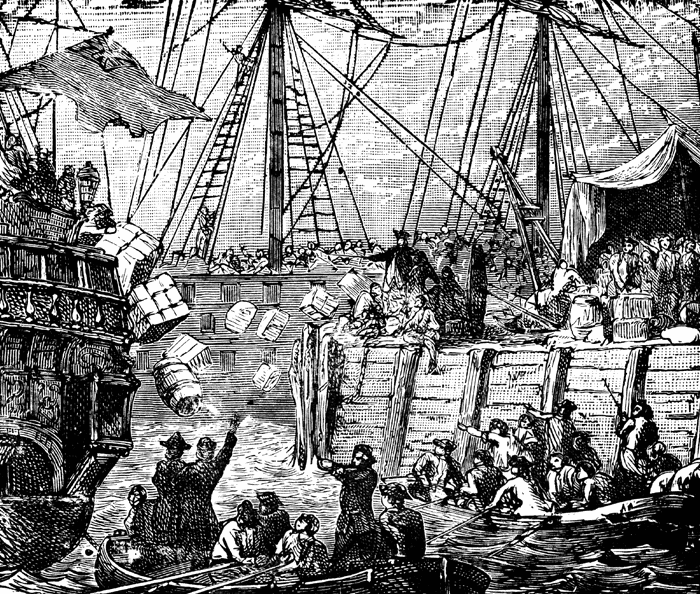
American colonists had  been affected by taxes put by parliament. They saw this taxes as another example of taxation without representation. Colonists had no representation in parliament, therefore they could not vote in favor or against this taxes. Tea was one of the favorite drinks among colonists and British decided to pass on the Tea Act. A tax had already been  put on tea and colonies didn't approve it,This act would almost guarantee that the colonists would buy tea form the East India Company. The East India Company sold the tea extremely cheap even with the taxes, but colonists didn't buy it because they thought they were being tricked by the parliament. Instead, colonists bought  the smuggled Dutch tea.Colonists got really angry and they thought they should do something to make the British know that they did not like this. On December 16, 1773 the Sons of Liberty lead a nonviolent protest in which they disguised as Mohawk Indians and bordered three British ships. This were the Darthmouth, Eleanor and the Beaver. This ships were full of tea because colonists were not buying it. Thomas Hutchinson, the Boston governor,did not allow the tea to be sent back to England. Colonists dumped 342 crates full of tea overboard. This was about 90,000 pounds of tea. This event was known as the Boston Tea Party.
Even though the colonists were disguised as Native Americans, British knew that colonists had done this. The same day there had been a meeting led by Samuel Adams which was for discussing the taxes on tea. It is unclear if this event was planned by Samuel Adams or if just a group of people got mad and decided to do this. We know that this was an action done by colonists to defend their rights. The business of tea had been long affected due to this taxes. Colonists definitely believed that they should do something to solve this problem. The Boston Tea Party was a key event for the American Revolution.

The Boston Massacre

The Boston Massacre was a fight that happened on March 5th, 1770 between a drunken crowd or colonists and British soldiers. The name "Boston Massacre" was given to the event by the Sons of Liberty, particularly by Samuel Adams. Five colonists were killed. Three died on the post and two were wounded and died afterwards. The victims of the incident were a black sailor named Crispus Attucks, a ropemaker by the name of Samuel Gray and a mariner called James Caldwell. Those who died afterwards were Samuel Maverick and Patrick Carr.

    Crispus Attuks, black sailor


The occurence began with a crowd of drunk colonists following and attacking a soldier. The soldier took refuge in the House of Customs, where several soldiers were protecting the custom officials. These soldiers were led by a British officer named Captain Thomas Preston. As the colonists continued to attack, the soldiers' increasing anxiety caused them to fire, despite Preston's orders. This led to the resultant deaths of the five colonists. A town meeting was called demanding the removal of the British troops and a trial for the captain and his men for murder. Six colonists were wounded in this accident.

    The Boston Massacre, by Paul Revere

The trials for the captain and his men were two of the longest in history. It was the first time a judge applied the term "reasonable doubt". The captain and his soldiers were defended by John Adams and Josiah Quincy II. They won the trial and gained the release of the soldiers. Two of them were found guilty afterwards for manslaughter. The accused soldiers were:

Captain Thomas Preston
Corporal William Wemms
James Hartigan
William McCauley
Hugh White
Matthew Kilroy
William Warren
John Carrol
Hugh Montgomery

The British were tried before the Superior Court of Judicature, the highest court in Massachusetts.

    John Adams, defense lawyer


Federal Hall where the Stamp Act Congress took place

The Stamp Act


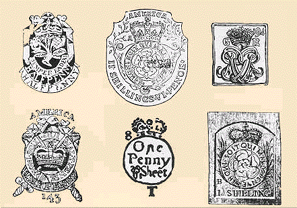
Colonists were angry since parliament had been taxing them. The Stamp Act , was passed March 22,1765 but was going on effect until November 1 of that same year. It became the  first direct British tax. The Stamp Act stated that colonists had to pay a tax on all printed paper such as magazines, newspapers, books, deeds and legal documents. This Act was called like this because colonists were supposed to buy paper from the British. This paper would have a stamp that showed that the colonists had payed the tax. The tax had to be payed with the British currency and not with the colonial money. The purpose of this tax was to help pay the troops in colonial America after British had won the French and Indian war. The British government thought that the colonies had received the most benefit from the soldiers  so they should at least help the British pay for them.
On the other hand the colonists thought they should not pay taxes on something they had been doing for free many years. They thought that there was no need for the taxes or the troops. Colonists believed this was  another example of taxation without representation. They argued that since they didn't have a vote in parliament they should not be paying a tax for them. Colonists thought they could only be taxed by their own representatives.  The colonists responded to this act with legislative protests and street violence. Colonists believed that this threatened their prosperity and their liberty, and that if they accepted this tax  many more would come. Everyone who was in favor of the Stamp Act was considered an enemy of the colony.

In response to this situation,the colonists gathered in the Stamp Act Congress. This was the first congress of the american colonies. Representatives from nine of the thirteen colonies went to New York City from October 7 to October 25 ,1765. The purpose of the congress was to organize a protest against British taxation. Representatives of this colonies decided on the non importation agreements. This meant that they wouldn't buy any British product. England was strongly affected by this economic boycott so they repealed the Stamp Act. Even though parliament  repealed the Stamp Act on the same day they  passed the Declaratory Act which stated that the parliament had the right to tax and make laws in the colonies.

Monday, November 18, 2013

French and Indian war!


In the 1750s, Britain and France had colonies in North America. The British wanted to settle in the Ohio River Valley and to trade with native Americans. Britain declared war on France. The war for control of the valley was called French and Indian war. Most American Indians in the region were allies of the French. The American Indians liked the French because they traded but didn't settle on the land. This was the bloddiest war in the century. It took more lives than the American Revolution, involved people on three continents, including the caribbean. France and Britain were fighting in Europe. 


 British Colonists wanted to take over French land in North America. British soldiers fought against French soldiers and native Americans. Native Americans joined in te battle against the British because they were afraid the British would take over their land. In Europe they gave this war the name of seven year war. In 1754 a congress of the British colonies met in Albany, New York because Benjamin Frankling thought colonies should work together to defeat France. Each colony would still have its own government, they would also create one together to decide important issues. His idea was rejected because colonists didn't want to join together under one government. In 1557, Britain sent more soldiers to North America to defeat the French in Canada. In 1763, Britain and France ended the war and signed the treaty of Paris. France gave Britain control of Canada and most of the land of the Mississippi River. 


French Indian War Burning at the Stake


This picture shows Native Americans with a man bound to a stake.


 Major General James Wolfe captured Quebec.


Conclusion!


 The war ended with the peace treaty of 1763. British got most of the French land in North America. Also as a result of the war, the British began taxing the colonists to pay for the war! Although war with frenches ends in 1763 the British continued fighting with Indians over the issues of land claims. The results of the war effectively ended French political and cultural influence in North America. England gained amounts of land and got stronger. War, however also brought a bad relationship with native Americans and england. The effects of the French and Indian war played a mayor role on the relationship between England and its colonies that eventually led into revolutionary war.